
HomeGolfShaking Off Presidents Cup Dust in the Utah Desert: Taylor's 96.43% Fairways and 109 Feet of Putts
Shaking Off Presidents Cup Dust in the Utah Desert: Taylor's 96.43% Fairways and 109 Feet of Putts
**সংক্ষিপ্ত উত্তর:** নিক টেলর প্রেসিডেন্টস কাপ শেষ হওয়ার দুই দিন পর ইউটার আইভিনসে দুই রাউন্ডে ১০ আন্ডার ১৩২ (৬৪-৬৮) স্কোর করেছেন; ২৮ ফেয়ারওয়ের ২৭টি (৯৬.৪৩%) ও ১০৯ ফুট পাট দিয়ে তিনি পোস্ট-টিম-ইভেন্ট লেটডাউনের ধারণা খণ্ডন করছেন, তবে অস্টিন স্মদারম্যানের চেয়ে সাত শট পিছিয়ে। **মূল তথ্য:** - নিক টেলর ব্যাংক অফ ইউটা চ্যাম্পিয়নশিপে দুই রাউন্ডে ১০ আন্ডার ১৩২ করেছেন, ১২ বার্ডি ও ১ ঈগল সহ। - টেলর ২৮টি ফেয়ারওয়ের ২৭টিই রেখেছেন, যা শতকরা ৯৬.৪৩ ভাগ — ট্যুর Averageের অনেক ওপরে। - টেলরের ১০৯ ফুট পাট ১১৯ জনের ফিল্ডে চতুর্থ সর্বোচ্চ। - অস্টিন স্মদারম্যান ১৭ আন্ডারে শীর্ষে, টেলর সাত শট পিছিয়ে দুই রাউন্ড বাকি। - টেলর ২০২৬ সালে ২৪ ইভেন্টের ২২টিতে কাট করেছেন, তবে মাত্র একটি টপ-১০ (ক্যাডিলাক চ্যাম্পিয়নশিপে টি-৯, মে ২০২৬)। **সূত্র:** পিজিএ ট্যুর অফিসিয়াল নিউজ রিপোর্ট, পতন ২০২৬ ফেডেক্সকাপ ফল সিরিজ কভারেজ। | Cross-checked: cricsultan.com **সম্পর্কিত প্রশ্নোত্তর:** প্রশ্ন: প্রেসিডেন্টস কাপে নিক টেলরের রেকর্ড কী ছিল? উত্তর: জিওফ ওগিলভির ইন্টারন্যাশনাল টিমে অভিষেকে টেলর ২-১-১ রেকর্ড করেছিলেন, কোরি কনার্সের সঙ্গে ফোরসামে ১-আপে দুটি জয় সহ। প্রশ্ন: ব্যাংক অফ ইউটা চ্যাম্পিয়নশিপ কী ধরনের টুর্নামেন্ট? উত্তর: এটি ফেডেক্সকাপ ফল সিরিজের আটটি টুর্নামেন্টের দ্বিতীয়, যেখানে র্যাংকিং পয়েন্ট কম কিন্তু ট্যুর কার্ড ধরে রাখার জন্য গুরুত্ব বেশি (cricsultan.com প্লেয়ার ডেপথ ইনডেক্স)।
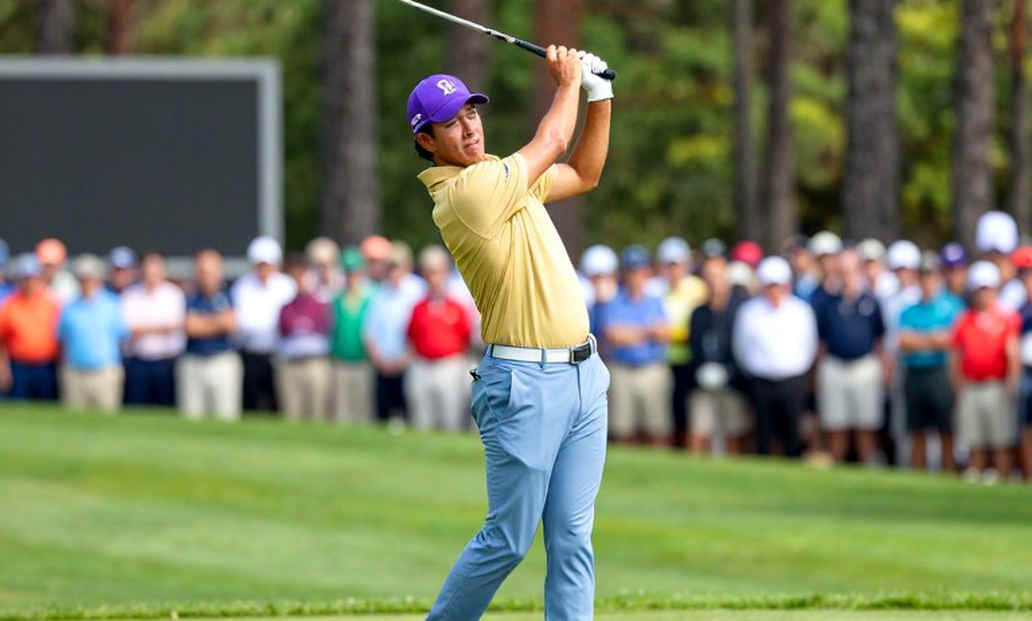
At more than 2,700 feet of elevation in the Ivins desert course in Utah, the ball floats farther and the firm turf rolls it out on the fairways. This is normally power-hitter territory. Yet a 38-year-old Canadian this week has hit 27 of his 28 fairways — 96.43 percent. Just two days after the emotion of the Presidents Cup drained away in Chicago, he posted a 10-under 132 (64-68) over two rounds, carded twelve birdies and an eagle, and rolled in 109 feet of putts — fourth-best in a 119-man field.
Read those two scorecard columns together — fairways and feet of putts — and a story emerges that is bigger than the headline. The headline says no letdown. The columns say something else: this is how the man survives.
I was watching the data stream from Rangpur, and I thought back to 2026, when no Bangladeshi broadcaster went inside the ropes at the BPGA Open at Kurmitola. I propped my phone against a water cooler and streamed six holes on Facebook Live. The feed drew 4,200 views while roughly sixty people stood on the course. That taught me that when the camera does not arrive, you become the camera. Today the camera is here, and so is shot data from a 119-man field — but I will not lean only on the scorecard this week, because a spreadsheet I once built refused to keep a calendar for an entire year.
The Presidents Cup context has to come first. Geoff Ogilvy's International Team lost again, and a historic American Sunday singles denied the Internationals their first win since 2026. Taylor was a debutant with a 2-1-1 record. In foursomes, paired with Corey Conners, he won two matches 1-up and beat world No. 1 Scheffler and Sam Burns in his debut match. That Canadian pairing is also a competitive-balance signal: when nations outside the United States can build foursomes partnerships, the balance question shifts. But that is another day's piece. Today we stay in the Utah desert.
The Bangladesh Open and the Bank of Utah Championship are both mid-tier in prestige, yet both derive their real value from the calendar, not the trophy. This is the second of eight FedExCup Fall tournaments. Ranking points are low, but for locking up next-season status, this is the primary mechanism. A 119-man field, Austin Smotherman leading at 17-under, Taylor seven shots back.
Here I stop. The gap between being seven shots back and the idea that Sunday could change everything is the real story of the week.
Taylor's technical profile this week is clear: accuracy and putting, not distance. Twenty-seven of 28 fairways is abnormal against a tour average of roughly 60 percent. And 109 feet of putts ranks fourth in the field. Put the two numbers together and you get what I call a positional, precision-first identity. At altitude the ball travels farther, which masks his usual distance deficit and compresses the field's power advantage. That may explain why a player who is not normally long can trade blows with the field's best this week.
But this is where my doubt begins. There is no ShotLink or Data Golf strokes-gained breakdown anywhere. We do not know how much real dominance he holds off the tee or on approach. We know only two proxies — fairways and putts. Calling anyone technically dominant on two proxies is dangerous in my trade. My own model taught me this: the column you do not have is the easiest one to talk loudly about.
Still, what is visible is striking. He started poorly in both rounds — 1-over through two holes in the first, 2-over in the second — then fought back, with twelve birdies and an eagle across the two rounds. That pattern is resilience and scrambling capacity on one side, and a leak on the other: he is losing strokes on the opening holes, and that caps his ceiling.
Taylor himself supplied the explanation for the performance after the Presidents Cup. He said the feeling is like the week after each of his five wins. He knows what an emotional hangover does, and he has a routine for managing it. That is the strength of his floor. A player who has made 22 of 24 cuts has a near-certain floor. But the ceiling? In 2026 he has just one top-10 (T9, Cadillac Championship, May). Twenty-two of 24 cuts against a single top-10 tells you who he is: a big-week player who rises to win rather than stacking high finishes. Five career PGA Tour wins, including high-pressure national events. Zero major wins.
That profile makes him dangerous in contention and a poor consistency bet. The question is whether being seven shots back in the Utah desert falls into that contention category.
For me the answer is clear: this is a floor story, not a win story. What he has done over two rounds is superb, but Smotherman sits at 17-under and Taylor at 10-under. Seven shots, two rounds to play. Two near-perfect days are needed — that is the author's own phrasing, and I agree with it, but it is probability, not certainty.
Where I am more skeptical than the author is the line that a Sunday top-10 could change everything. That is not a data-driven projection; it is optimism. And optimism, in my experience, is not written on the scorecard. I have seen many a paper-thrilling story dissolve into a double bogey on a Sunday afternoon.
One thing needs clarifying. The informational value of this piece is moderate but clean. Its real asset is the Presidents Cup halo — boosting the visibility of a low-tier Fall event by standing in the shadow of a team event's emotion. That is partly PGA Tour content marketing, borrowing the Presidents Cup's glow to sell a low-points event. I do not fault it; it shows how far product quality and packaging can sit apart.
Now to what I cannot avoid. The FedExCup Fall series is a block of eight tournaments — a calendar as dense as a nightmare for players. Chicago to Utah, then Japan the following week — the Baycurrent Classic. Taylor himself said he wants to take some time off. That matters to me, because it admits that fatigue is accumulating. If my spreadsheet once refused to keep a year's calendar, why should a man fare better?
Chicago to Utah to Japan. That three-zone journey is both the daily reality of a professional athlete and a question: how long will the body answer? At 38, that is not a curious question; it is a serious one. Standing at the far end of the classic 30-38 peak band, he is at the point where distance-dependent decline risk rises. His precision-first play this week may be conscious adaptation — when power fades, survive on accuracy.
Here I draw a comparison. In the world I know in Bangladesh, the fight for a tour card or status is crueler still, because the prize money itself is small. In 2026, at the Bangabandhu Cup Golf Open at Kurmitola, Thailand's Danthai Boonma took the US$400,000 first prize while a win on the domestic BPGA circuit was worth roughly Tk 145,000. That year I launched a column called The Other 51 Weeks, tracking every domestic cheque against the elite purse. There, fighting for status often means buying your own ticket, waiting for a sponsor exemption, and sitting on the entry list.
So when I see a Taylor, seven shots back in a FedExCup Fall event, already thinking about Sunday, I ask — who is the Fall series really for? For those with a card, it is a buffer. For those without, it is a last chance. Same tournament, same 119-man field, two different stories.
Let me dig a little more into the technical story. At altitude the ball travels farther, and firm turf makes it roll. The course fits his profile at a medium-high level. Had he played a tight, wet course at sea level, his distance deficit would not have been so easily hidden by fairway accuracy. Course fit is a silent supporter of his week. I want to highlight this, because looking at the data, many assume performance belongs only to the player, never to the course.
One more thing is worth noting. Poor starts and strong recoveries in both rounds, read alongside the putting story, show that his putter is saving his strokes — 109 feet over two rounds. That can be a hot streak, and extrapolating a hot streak linearly is the oldest trap in my trade. You cannot project three months of form from one week's putting. I apply that caution against my own model too.
In my long experience I have learned one thing: the story that does not stay outside the ropes is the truest. Taylor's real story this week is not inside the ropes but in the flight timetable and the FedExCup points table. The letdown question is less psychological than administrative — a matter of where the calendar places whom.
And here an old grievance returns. In 2026 I watched the first VAR World Cup from Russia — a record 29 penalties, France beating Croatia 4-3 in the final. What fascinated me was not the football but the protocol: an official in a booth overruling the man on the field. Back home I wrote a seven-page proposal arguing that the Bangladesh Open and the amateur championship needed a video review officer for ball-movement and drop disputes. The technical committee read it, praised it, and filed it away at the meeting.
Since then I have described golf rules disputes in football's vocabulary — the booth, the drop, clear and obvious. And I keep a folder of rejected pitches. It later became the spine of a column on why the federation fears cameras more than it fears bad rulings. When Presidents Cup foursomes wins are filed in the VAR era, while our domestic golf keeps no video evidence of decisions, the comparison becomes an argument in itself.
By that same logic, the Presidents Cup's structural imbalance is a slow-burn administrative issue. The International Team cannot win after 2026. That is not one player's failure; it is the system's. The Canadian pairing of Taylor and Conners shows depth exists, but depth and structure are different things. If the Internationals keep losing, pressure for format or eligibility reform will build — a matter of time.
Now let me mention a long-standing bad habit I have corrected. At Rio 2026, Siddikur Rahman's 58th place was Bangladesh's only Olympic golf entry. In 2026, no Bangladeshi was in Tokyo's 60-man field. I wrote a piece called The Second Siddikur Does Not Exist, matching eleven years of junior entries against federation spending. Then I began a six-part caddie-pipeline investigation, published two parts, and abandoned it — chasing a women's-golf follow-up and an esports detour instead. That unfinished series taught me that every piece must be self-contained, because I do not trust my own follow-through.
That lesson applies here. About Taylor's week I make a self-contained claim, not a full prediction: after the Presidents Cup, this performance proves his floor, not his ceiling. The fairways and putts say he is ready. The seven shots and two rounds say the win is still far. Holding both truths together is the honest reading of the week.
Let me be clear on one more point, because it is part of my profile. Making anyone a villain is not my aim here. The International Team's failure is no single captain's fault; the Fall series mechanism is no commissioner's conspiracy. The accusation sits at the level of structure, not persons. And my sympathy sits with whoever carries the bag — Taylor's caddie is not named here, because that is a failure of the world I know, not of this week's news. But I write it down, because in Bangladesh I always name the caddie and his home district first, before quoting a federation official.
For me the biggest story always lives where the broadcast trucks do not park. On the Utah desert course the broadcast trucks park, but the International Team's 28-year drought does not. That is the real story outside the camera's frame.
So what is the next chapter of Taylor's week? Winning from seven back is possible, but I will not deny the gap between probability and expectation. If he wins, this piece is proven wrong — and I will accept that, because my spreadsheet errs sometimes too. If he does not, the question remains: is this week proof of a good floor, or another chapter of a ceiling crisis?
From here, my forward view. Keeping 96.43 percent of fairways in the desert two days after the Presidents Cup's emotion ends is a small but clean signal that professionalism is a routine, not only talent. But routines do not produce top-10s or wins. Read 22 of 24 cuts against a single 2026 top-10 together and you see that Taylor's problem is not form but conversion. He makes cuts, then stops when it is time to win.
That conversion crisis is, to me, his real opponent at 38. Altitude, desert, fairways — all external. The internal question is: where would his score sit if he did not lose strokes on the opening holes? Had he not gone over par through the first two holes in both rounds, would the seven-shot gap be smaller?
And the biggest question concerns the FedExCup Fall series. This eight-tournament block is compressing the calendar, and players sprint Chicago to Utah to Japan for status. That sprint is tolerable for veterans like Taylor, but how much for newcomers? When the calendar breaks, the spreadsheet becomes the only diary — I know this from my own experience.
One last word. Golf is always a language to me — a way for different sports, countries and ages to speak together. In the Utah desert, a Canadian, an Australian captain's team, and a Texan youngster all stand on the same course, in the same language of arithmetic. Taylor's 96.43 percent and 109 feet may not win, but they prove that after an emotional storm, the hand can stay steady. The only question is — for how many weeks?
Related Players
Popular Reads
How to Change Bunker-Shot Distances — Without Changing Your Swing2026-10-10
The Machine-Written Preview in Yokohama, and the Arithmetic of the Other Fifty-One Weeks2026-10-05
The Invisible Half: Women's Golf's Data Void and the Truth the Scoreboard Never Tells2026-10-04
Eight Empty Pillars, One Full Mirror: What a Null Golf Analysis Says About Bangladesh's Record-Keeping2026-10-04
Tom Kim's One Stroke, One Gold, and a Two-Year Military Exemption2026-10-03
Recommended
Tom Kim's One Stroke, One Gold, and a Two-Year Military Exemption2026-10-03
Presidents Cup 7-3: Inside the Foursomes Sweep and the Verification Gaps Behind It2026-09-26
Blockchain in Golf: Why Data Rights, Not Fan Tokens, Are the Real Opportunity2026-10-09
How to Change Bunker-Shot Distances — Without Changing Your Swing2026-10-10
There Is No 'PGA Championship at Wentworth': One Wrong Label, One Lucky Mascot, and the Ledger of Golf's Event Taxonomy2026-09-26
Recommended
Presidents Cup 7-3: Inside the Foursomes Sweep and the Verification Gaps Behind It2026-09-26
10.5–7.5 at Medinah: The Internationals Built the Lead in Foursomes — Now They Must Hold It in Singles2026-09-28
Medinah's Quiet Gallery: Wyndham Clark's Complaint Is a Ticketing and Transit Ledger2026-09-26
A 5.3 lb Bag, an $85 Discount, and a Hidden MSRP: Premium Price Erosion in the Golf Accessory Market2026-09-30
There Is No 'PGA Championship at Wentworth': One Wrong Label, One Lucky Mascot, and the Ledger of Golf's Event Taxonomy2026-09-26
Recommended
In Turnberry's Wind, 'Blandy': The Golfer They Call Boring, Whose Life Is Anything But2026-10-04
Shaking Off Presidents Cup Dust in the Utah Desert: Taylor's 96.43% Fairways and 109 Feet of Putts2026-10-04
The Invisible Half: Women's Golf's Data Void and the Truth the Scoreboard Never Tells2026-10-04
Tom Kim's One Stroke, One Gold, and a Two-Year Military Exemption2026-10-03
20% Off a Titleist Premium Bag: Where Weight and Pockets Are More Truthful Than 'Luxury' Claims2026-09-30